Monday, February 7, 2022

Whatever the Weather: January 2022 Bird Report

This article and the images within were provided courtesy of S. Grover.

There is a pattern to when we see certain species of birds during the year. For example, in summer we record Swallows and in winter, Whooper Swans. This cycle is repeated annually and is, by and large, predictable. This January there was the usual selection of birds to observe plus one or two unexpected visitors thrown in for good measure. All well and good, I hear you say. However (there is always a ‘however’!) this month differed from previous years in that there seemed to be a lack in the abundance of some species. Now, age in humans comes to those who wait or are fortunate enough to live a long life. Like any drug it has side effects, one being that although the mind may be willing the body is often reluctant to follow suit. Another burden purported to age is wisdom; but whether it is wisdom that I stay longer indoors at home in the warm and dry when outside it is raining and blowing a hoolie, or it is infirmity getting the better of me, I cannot say. There just seemed to be less birds about, okay!

Numbers of ducks in general all seemed to be down; those of swans and geese appeared to be lower than usual; waders were thin on the ground and Linnets and Twite were frequently difficult to come by; and so on, and so on - the story repeats itself for a range of birds.

The adorable Pale-bellied Brent Geese were at least one constant throughout the month, with over 200 regularly to be seen feeding in the grasslands beside the Wig track. Amongst them was ‘HJ’, so named because it wears a red colour-ring on each leg coded with the letter H on the right leg and J on the left. The same bird, incidentally, was also present last year. Seeing it on a more or less daily basis signifies that at least one member of the flock (and, presumably, others too) overwinter here, rather than there being a continual passage of birds moving through.

Pink-footed Geese were usually heard calling, either in the morning or in the evening when they flew over the house. The abuttal fields at Loch Connell harboured at least 2000 birds on the 16th and a similar number were in fields north of Kirkcolm, on the 20th. The ‘Connell Fields’, as our household has come to refer to them, also held a pleasant surprise - and a rare one at that - on the rainy 9th in the form of nine Greenland White-fronted Geese. Their overall dark colouration readily separated them from the other grazing geese.

Pink-footed Geese flying toward Loch Connell.

The number of Shelducks about the Wig can usually be counted on one hand, so 17 at the Scar (on the 14th) was notable. Piltanton is generally better suited to them, as evidenced by the 87 logged there during a Wetlands Bird Survey count (WeBS) on the 23rd.

Common Scoters were widely scattered across Loch Ryan and could be observed daily in small groups coming in with the rising tide. They peaked at 193 birds on the 14th. Velvet Scoters were noted on just three occasions: three males on the 8th and 9th and two males near the month’s end, on the 27th. The only Scaup at the Wig were a male and a female on the 2nd, whereas off Bishop Burn, a count of 604 was made on the 23rd.

In Wig Bay Long-tailed Ducks were conspicuous on some days but not others. Sometimes this was attributable to the weather, sometimes not. A fickle bunch of ducks, for sure! But then, with the highest gathering of birds being only eight strong (on the 17th), it is perhaps no wonder that they could easily go undetected, especially in choppy conditions when their contrasting plumage render them near invisible on the water.

The spit known as the Scar is often a place of respite for Eiders and at times large gatherings may occur there, providing an opportunity for a curious birder to separate out the sexes. In the past the bias has heavily been in favour of males, accounting for over 95% of birds. But recently, whether due to changing climate or other factors, the proportion of females has risen. Of 144 birds registered on the 4th, no less than 54 (38%) were females.

The pair of Goosanders noted last month at Wig Bay were still present to at least the 17th and were known to commute between there and the waters off Soleburn. Loch Connell held the highest count of this species, however, with 15 (including ten males) on the 22nd.

A pair of Goosanders close to shore at Wig Bay.

Although Red-throated Divers were daily visitors to Loch Ryan, numbers of them generally appeared to be on the low side, with the highest count of 39 on the 17th. Singleton Great Northern Divers were observed on the 3rd, 7th and 25th. Likewise, a Black-throated Diver was noted on three dates: the 17th, 20th and the 30th. Numerous sightings of a Pacific Diver were spread across the month. On several occasions it was the first diver of the day to be seen, coming in with the rising tide ahead of its more abundant Red-throated cousins. Maybe it spent each night closer to the mouth of the sea loch than any of its relatives, but exactly where any of them overnight is a mystery as yet unsolved. Prolonged and regular observation of the Pacific revealed an additional note of interest: whenever it dived to feed it stayed under for approximately 30 seconds; similar sized Red-throat’s in the same area submerged for an average of 50 seconds.

The 12th of the month was an extraordinary day on the Loch Ryan rarity front. Not only was there the diver species mentioned above, also, and within the same ‘scope view was a Black-necked Grebe, and mere minutes later a Great White Egret at the marsh. Interestingly, the grebe was seen again the following day at the Wig, but not thereafter. In days gone by Loch Ryan was the winter stronghold for this species but for the past ten years they have been absent.

Cormorants have been noticeably scarce about the Wig of late so it is reassuring in some small kind of way to report the eight birds at the Scar on the 14th.

Ringed Plovers adopted the usual practice of ‘now you see me, now you don’t’, but enough of them stayed together in one place for a count of 51 to be logged, on the 4th. There was only one record of Golden Plovers at the Scar: 14 on the 10th. A much larger aggregation of approximately 600 birds was recorded along the west coast of the North Rhins by my son and daughter when they walked from Dally Bay to Corsewall Point on the 5th.

Grey Plovers were seen almost daily, with probably the same four birds present throughout the month, as indeed was a Greenshank. A notable eight of the latter mentioned species was recorded at Piltanton during the WeBS count on the 23rd. Bar-tailed Godwits were sparse about the Wig but 18 on the 29th was an excellent find. Curlews were widely scattered in small groups on the exposed flats when the tide was out, or equally widespread when feeding in grasslands. One such field held a flock of 130 birds on the 3rd. A lone Purple Sandpiper at the Scar on the 19th was a rare treat.

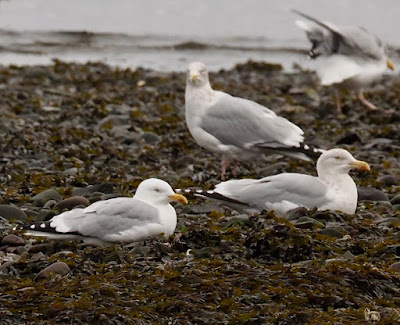
As mentioned last month gulls are infrequently counted and, when they are, estimations are generally the order of the day. I prefer to count individuals in flocks whenever possible. An early evening gathering at the Scar on the 12th was guessed to comprise about 2000 birds, which included a definite 984 Common Gulls. The remainder, though not counted, consisted of Black-headed Gulls and a substantially larger number of Herring Gulls. The latter species is of particular interest to the gull aficionado because of the complexity and diversity of the many races - or even species, according to some authorities - that science ascribe to this species. The archetypal ‘British’ Herring Gull has a pale, silvery-grey back and upper-sides to the wings - though it should be noted that the tone of grey varies with the light conditions and the angle from which any given bird is viewed; a detail which should be considered and interpreted with the utmost caution. These are the birds you will encounter most frequently about Loch Ryan and form the bread and butter against which other variations may be assessed. Occasionally, however, there is jam to be had with your spread in the form of slightly darker-backed birds that show less black in their wing-tips: just like the two I saw at Loch Connell on the 22nd amongst 41 ‘normal’ Herring Gulls. They were probably of Scandinavian origin or a more northerly counterpart; still Herring Gulls, of course, but an interesting diversion you might wish to consider throwing into a conversation when you are next invited to a party and hanker to impress your friends! Or … maybe not … depending! But, before we leave the gull topic behind, I should mention the only sighting I had of a Mediterranean Gull this month, at Loch Connell, on the 30th: it was an adult with a well advanced, black summer hood.

'Archetypal' British Herring Gulls.
Birds of prey always seem to generate excitement among birdwatchers. January had its fair share of them. One species in particular, however, was notable by its absence, which only became apparent to me when my daughter asked: “Where have all the Buzzards gone?” My answer was twofold: “They occupy a larger territory in winter than summer, so the chances of seeing them are thus reduced; secondly, in order to conserve energy they spend more time perched on lookout posts than cycling in the air and are, consequently, less obvious.”

A spectacle on the 12th was a Merlin seen hunting a Skylark, just as the sun was setting. Such predator/prey relationships might seem macabre but they are quintessential events in nature’s struggle of survival. The pursuit was a series of fast and furious moves and countermoves, which continued for what seemed like an age but in reality must have been only a few minutes in passing. The outcome was uncertain, as my daughter and I lost sight of the engagement when the birds dropped below the hedge-line and disappeared into the deepening darkness of the advancing twilight.

Now for passerines, which I am sorry to say, have been reduced to the mentioning of but one species this month (excepting the Skylark, above, of course). They will rise to prominence in a future issue of this blog, I am sure; but for now … Yellowhammers! Once a familiar sight and sound in the countryside pretty much everywhere they have rapidly, and dramatically, declined to become just a memory to many folk. Nowhere is this loss more apparent than in the North Rhins. But there is hope, if nothing more. When my son and daughter went for their long walk on the 5th they passed the farmstead of Knocktim. Here, much to their delight, they spied a stunning, male, Yellowhammer; and, in so doing, they added a valuable record of the species to the archives.


Thanks to Eleanor and Benjamin Grover for providing company, and records, for this month’s posting.

Tuesday, January 25, 2022

Wrapping up 2021 - December Bird Report

This article and the accompanying images were provided courtesy of S. Grover.

When people speak of the environment and the species within it the words ‘common’ and ‘rare’ pop up time and again. Be warned… they are ‘dangerous’ words and should come with a warning. Why? Because they easily entrap and fool the unwary reader. Their meanings can vary, and change, depending upon the context in which they are used. I confess, I am as guilty as the next person in using them even though I try hard to avoid any confusion.

…But enough philosophising. On with the blog. 

Good numbers of Pale-breasted Brent Geese were present throughout the month. Depending on the state of the tide they could readily be seen at Soleburn, Bishop Burn and the Wig, or flying low across the water when commuting between these sites. At high tide they were usually observed grazing the grass fields bordering the Wig track. It was here that the month’s peak of 387 birds was logged on the 8th. The same day also hosted an adult Bewick’s Swan that was noticed flying in low over the bay and over the heads of the grazing Brents before settling close-by in the ‘Pool Field’. The sightings of both species were notable in their own way and even more so considering the clock had not yet struck nine in the morning and the rest of the day lay expectantly ahead!

Incoming! Low-flying Bewick's Swan.

It is amazing how the numbers of any given species can differ markedly between sites separated by just a few miles. Shelduck provide a good example of this. At the Wig the highest count of them was seven on the first three days of the month. At Piltanton, however, just a short hop away at Luce Bay, 144 birds were recorded during a Wetland Bird Survey (WeBS) count on the 20th.

Pintail are always scarce birds on Loch Ryan so it was nice to find a pristine male at Bishop Burn on the 28th. Loch Connell hosted 140 Teal on the 5th and in excess of 336 on the 12th. Similar to Shelduck, Scaup display concentrated occurrence in favoured areas. On a much more local level: 15 was the highest count at the Wig whereas the southern end of Loch Ryan, off Bishop Burn, held 642 on the 28th. Velvet Scoters are always pleasing to come across; four sightings spread over the month was really quite exceptional and included a party of four birds on the 27th. Red-breasted Mergansers are highly mobile and wander frequently about the loch. Counting them with any accuracy therefore is typically a challenging task, even when the weather conditions are favourable for doing so: a high of 65 on the 2nd might have been an undercount or indeed a true representation of the number of birds. In recent years Goosanders have become regular visitors to Loch Connell during the winter but they are still scarce birds on Loch Ryan.  A male and female at Wig Bay from the 15th to at least the month’s end were, thus, a notable delight.

Of the species of diver that regularly frequent Loch Ryan the Red-throated is the most abundant and commonly encountered: 33 on the 2nd was the biggest tally of the month. Great Northern Divers were noted on three occasions with one on the 2nd and 9th and two on the 27th. Black-throated Diver is generally the scarcest of the regular trio: two were observed on the 16th and a singleton on the 27th. Excitement was generated when a bird showing the characteristics of a Pacific Diver was seen on the 17th and 31st. Perhaps it was the returning bird from last year.

Sketches demonstrating the features of the Pacific Diver.

Dabchicks, or Little Grebes, are occasional visitors on Loch Ryan. An unexpected find was one on the recreational pond at Agnew Park, by the sea-front in Stranraer, on the 23rd. Great Crested Grebes are generally concentrated at the southern end of the sea loch where they may readily be seen from the shore-line bordering the town; 23 at Wig Bay on the 2nd was thus unusual.  A single Red-necked Grebe was observed about the Wig on two consecutive days, the 12th and 13th - a disappointing showing compared to the same period last year. At the same place Slavonian Grebes were regular in small numbers: 38 on the 22nd was notable.

Visits from Little Egrets appear to becoming increasingly more frequent and, as yet, they still incite pleasure and astonishment in those of us lucky enough to see them. Singletons on the exposed flats at the Wig on the 2nd and 16th were very much appreciated. These sightings were, however, eclipsed by the presence of a Great White Egret (a species still very scarce in Dumfries and Galloway) found resting in the ‘Twite Fields’, on the morning of the 5th.

There was only one record of a Hen Harrier, a ‘ringtail’, observed leaving the edge of one of the Corsewall estate plantations at twilight on the 16th. An interesting observation of a Peregrine returns this species to the pages of the blog after a long absence. On the 30th, I was surveying the world from my house through my spotting scope, my eye fixed upon the ducks out in Wig Bay. In the background was the familiar chattering of House Sparrows.  Suddenly, all went quiet. The silence prompted me to cast my gaze toward the garden. Initially, nothing out of the ordinary drew my attention until my eyes refocussed on an object barely an arms length away from me.  There, perched on the roof of the house extension was a young male Peregrine. It voiced its disapproval of my appearance from behind my scope with a loud ‘kek-kek-kek-kek’ call, before promptlyflying away. The ‘conversation’ of the sparrows resumed almost immediately following its departure.

Water Rail are one of those species that go about their business unobtrusively. Exactly how many of them spend the winter on the estate marsh is anybody’s guess, but at least one betrayed its presence on the 17th by calling.

Although Greenshank are annual visitors in small numbers about Loch Ryan they are distinctly less common than their ubiquitous relatives, Redshank. There was just one at the Wig on the 28th, although three were noted at their more regular haunt of Piltanton, during a WeBS count on the 20th. Their red-legged cousins reached a maximum of nine birds at the Wig on the 2nd and 3rd compared to 56 birds at Bishop Burn on the 20th; this is another example of very local differences in bird populations and distribution. Woodcock, by way of their general nocturnal habits, are a typically under-recorded species; there were twilight observations of one on the 15th and 16th, two on the 17th, and another on the 24th.

Field sketches of the Wig's Greenshank.

Gulls often form sizeable flocks, especially when roosting or at loafing sites. Such a bewildering mass of often similar-looking birds can be a daunting prospect to many birdwatchers; consequently, large gatherings are infrequently counted or examined. I took the time to log 900 Common Gulls at the Scar, on the 17th; fading light precluded additional counting.  At the same site, but on the 9th, a Glaucous Gull in first-winter plumage was spied amongst a mass of Herring Gulls. An adult Mediterranean Gull was about the ‘Wig Fields’ on five occasions: the 4th, 12th, 13th, 20th and 23rd, whilst a second-winter bird was observed in the same general area on the 17th.

On the auk front, 31 was the highest count of Black Guillemots about Wig Bay on the 2nd, while an adult in full breeding dress was seen there on the 4th.

There are many species, which, for a variety of reasons are undoubtedly more abundant than the actual number of records of them might suggest. Nocturnal species such as the Tawny Owl is a good example in this category, with a calling bird noted on the evening of the 5th, 14th and 26th and two ‘hooting’ on the 17th. The diminutive Long-tailed Tit is another such species, with a single record of a party of nine on the 15th.

Grey Wagtails are generally scarcer in the countryside around here during the winter than they are, perhaps, within the warmth of the town of Stranraer. One at Loch Connell on the 5th was thus a nice find, as was one in Kirkcolm on the 14th. Pied Wagtails are more widespread and abundant than the preceding species, but once again, town dwelling birds significantly outnumber country-living birds at this time of year. A flock of 16 on the ‘Wig Fields’  on the 31st was most noteworthy. Also here, but on the 3rd, was flock of 38 Skylarks.

Blackcaps are typically summer visitors to our region but there was a handsome male in my garden on the 19th. Black Redstarts are rare here whatever the season. One on the harbour wall, beside Port Rodie, in Stranraer, was a delightful surprise in the rain shower that I found myself in on the 28th. Last, but not least, five Greenfinches along the Wig track on the 2nd was notable. This species was once common pretty much everywhere. It now appears on the ‘Red List (most threatened) of Birds of Conservation Concern’.

A Black Redstart brings a flash of colour to an otherwise grey day.

Friday, December 10, 2021

Inquiry and Exploration - November Bird Report

This article and the accompanying images were provided courtesy of S. Grover


Recording on a local patch can provide fascinating insights into the world on our doorsteps, should we take the opportunity to explore and interpret our findings.  It is a complex subject for sure, which raises more questions than answers, but that is the nature of exploration and inquiry.  As an example, Friday the 10th of November 2021 was a remarkable day on my patch: not for the number of rarities seen (of which there were none by the way) but because of the number of bird species logged - 72!  The monthly average was 45.  Generally, anything over 50 is good going: over 60 is excellent: and above 70 is outstanding and a rare event indeed.


Onward with the monthly summary…


Recent years have witnessed a change in the pattern of Mute Swans visiting Loch Ryan and a reduction in their numbers.  Regular feeding of the swans at Bishop Burn resulted in a large year-round flock, but since this activity has been discouraged numbers have dwindled and most birds vacate the area in November, or thereabouts.  A high of 91 birds on the 2nd was not maintained  and numbers reduced quickly to just six birds at the month’s close.  The strong passage of Whooper Swans seen in October ended abruptly with just nine at the Wig on the 2nd, although a singleton remained at Loch Connell all month.  Also, at the same site, Greylag and Pink-footed Geese peaked at 112 and 428, respectively, on the 21st, whereas Canada Geese hit 150 here on the 15th.  Pale-bellied Brent Geese were present at Loch Ryan throughout November with over 300 birds logged on four occasions: 352 on the 16th and 18th, over 320 on the 26th and 300 plus on the 30th.  Ordinarily this species does not come onto the fields to graze until after New Year, but ten were noted doing so at the Wig on the 1st.  Amongst the busy flocks of Brent’s in the bay was a single Barnacle Goose on the 19th.


Shelduck have begun to trickle back, having been absent since they left to moult elsewhere.  It was somewhat reassuring to see eight birds sat on the Scar on the morning of the 23rd.  This, however, paled into insignificance when compared with the 79 observed at Piltanton during a WeBS count on the 7th.  Teal were ever-present at Loch Connell, peaking at 126 on the 15th.  On the same day, but at the Wig, 384 Wigeon amassed, pattering and grazing on the exposed flats.  The adjacent ‘Twite Fields’ also hosted four, plump birds on the 28th which, itself, is an unusual observation; indeed, I cannot ever recall seeing these fields being grazed by them before in broad daylight.


Common Scoters can at times be hard to spot, even on gentle sea swells.  Small groups may be seen close inshore but more typically they are found out in the mid-channel of Loch Ryan, appearing as nothing more than dark blobs in the distance; such shapes seen diving in unison are invariably this species; occasionally they come together en-mass, small parties flying in from all directions to form sizeable, and more conspicuous, rafts.  One such flotilla of 107 birds formed on the 18th.  If this species can be difficult to see then just think about how hard it can be to pick out any similar-looking Velvet Scoters hiding amongst them.  Patience and keen observation are key here - plus, of course, luck!  A male on the 4th was the only record.


A male (left) and female Lesser Scaup

In excess of 250 Eiders were counted on the 13th, and 27 Goldeneyes were seen in Wig Bay on the 19th; six of the latter species were at Loch Connell on the 28th.  Also on this date, but at the Wig, was a party of 12 Long-tailed Ducks; all but one of which were males in dapper winter plumage.  A small group of Scaup frequented the Wig throughout the month, with up to 17 birds present on the 19th.  This species was of course more abundant down at Bishop Burn, with over 200 birds reported to me on several occasions by various visiting birdwatchers.  Of considerable interest was a pair (drake and duck) of Lesser Scaup among their similar-looking and commoner cousins at the Wig on the 14th.  Unfortunately they were not seen thereafter but might easily have been hiding within the rafts of Scaup at the southern end of the loch, awaiting discovery.


On the 2nd of the month 81 Red-breasted Mergansers were registered in the daily log, with 70 of these uniformly spaced like you might imagine in your mind’s eye a naval armada to be arranged.  The only records of Goosanders came from Loch Connell, with six birds present on the 21st.  The same site also hosted two male Pochard on the 15th.


Of the three regular species of diver to be found on Loch Ryan the Black-throated is the least common: one on the 2nd and another on the 18th were therefore a treat.  Great Northern Divers were noted on six days across the month, including three on the 9th and 10th.  Red-throated Divers were daily visitors, with a high of 62 on the 13th.  Great Crested Grebes were seen more frequently than is usual, including 34 at Wig Bay on the 10th.  Equally respectable in numbers were over 30 Slavonian Grebes registered on three occasions: 31 on the 9th, 38 on the 10th and 33 on the 13th; on the last mentioned date there was an impressive 12 birds together at the Wig.  The only observation of a Red-necked Grebe came, not from Loch Ryan, but from Piltanton, where a singleton was noted during a WeBS count on the 7th.


Despite the fact that Little Egrets are becoming more common and widespread in Britain they are still scarce visitors about Loch Ryan.  One frequenting the Wig on the 15th and a singleton at Soleburn on the 23rd were the only observations made.  Probably the last Gannet of the year was seen on the 1st as it flew past the Scar.  Shags were considerably more abundant than Cormorants; in excess of 150 lined up along the pier at Cairnryan on the 10th.  Mediterranean Gulls were observed on five occasions: a 2nd winter bird on the 5th and an adult on the 15th, 18th, 21st and 28th (probably the same individual) frequenting the Wig fields in association with Black-headed and Common Gulls.


Mediterranean Gull (centre) with Black-headed and a Common Gull


An injured bird of prey was reported to me on the 20th, only a few hundred yards from my home.  Immediate investigation revealed an immature Buzzard, sadly deceased.  Very much alive, however, was a female Hen Harrier observed quartering the ‘Twite Fields’ on the 5th, 22nd and 28th.  A Kestrel hunting over the same area on the 16th, 20th and the 28th was a most welcome series of sightings;  as, too, was a male Merlin which flew at speed over my house on the 24th.


Generally, if there are any Lapwings about my local patch, then Loch Connell is the first place to check for them.  The discovery of 128 of them there on the 15th was a pleasant surprise.  Golden Plovers, on the other hand, are more typically observed on the Scar at Loch Ryan, so 30 at Loch Connell on the 7th was notable.  This species tends not to linger for long in November, so 200 plus at the Scar on the 1st were brief visitors.  Ringed Plovers were present throughout the month, with the highest count being 134 (92 of which congregated on the the concrete hard-standing in the ‘Twite Fields’ on the 5th).  In contrast to the aforementioned, Knot are scarce at this time, as evidenced by just ten birds on the 1st and none thereafter.  A lone Ruff at the Scar on the 6th was an unexpected bonus, as were two Greenshank at the Wig on the 22nd.  Almost as unexpected was a party of 21 Redshank huddled together on the shore of the Wig at high tide on the 10th.  Bar-tailed Godwits come and go with the changing seasons but are never guaranteed at any time: seven at the Scar on the 28th was, thus, noteworthy.  Curlews are a more predictable offering to the birder although numbers at Wig Bay seldom match those found along the shoreline to the south: 74 on the 17th was a more than respectable tally.  Snipe can be very elusive, often secreting themselves away amongst dense vegetation.  To see seven of them in plain view out on the pebbles and cobbles of the Scar, on the 22nd, was akin to a revelation.


Snipe forgo their camouflage and flaunt themselves upon the Scar

It would be premature of me to claim ‘the last Swallows of the year’ here at the Wig, but three on the 6th could be regarded as strong contenders.  Blue Tits are hardly head-line news and, as a consequence, receive little mention in this series of blog posts.  A party of ten in my garden on the 19th was worthy of a note, I thought.  Of course, there are undoubtedly many more that pass through the garden on a regular basis but noting the largest flock seen at any one time is at least a start in beginning to understand a species’ true status.


I can go for days without seeing or hearing a Skylark at this time of year; a flock of 22 over the ‘Twite Fields’ on the 6th was the largest count of the month.  A Chiffchaff was a nice find along Fisher’s Lane on the 10th.  Equally scarce in November are large parties of Redwings and Fieldfares; 40 of the aforementioned species was an exceptional number in my garden on the 13th and 26 of the latter, flying south on the 10th, were of interest at a local level.  Three Greenfinches along the Wig track on the 15th and one singing in my garden on the 21st and 26th were also records of significance.  Lesser Redpolls turn up now and again, usually just in ones and twos, so a roving flock of 20 birds at the estate marsh on the 20th were a delight to see.  Rather similar-looking and just as ‘twittery’ are Twite, which often occur in much larger groups: 160 plus, over the Wig fields on the 5th and 120 at the same place on the 23rd were notable.


With disrupted weather patterns becoming a norm these days, that which was once predictable is no more, opening the door for anything to fly in.  Could December offer that special something?  In the meantime explore your own local patch and follow the leads of inquiry that will follow.


Monday, November 15, 2021

Dodging the Downpours - October Bird Report

This article and the accompanying images were provided courtesy of S. Grover

If the weather is fine the chances are that you will spend longer outside bird watching than if it is raining.  The more time you spend looking the greater the number of species you are likely to record.  Here on my local patch October was decidedly wet this year.  Fortunately, living in a house with commanding views over Wig Bay - coupled with the use of a decent spotting scope - I was able to witness nature despite the frequent downpours.

Mute Swan numbers on Loch Ryan remained pretty much constant throughout the month, with 108 being the highest count on the 17th.  Icelandic Whooper Swans were also frequent visitors at this site; some 60 birds mingled with their British mute cousins at Low Balyett on both the 15th and 21st.  They were more regular at Loch Connell, however; from my house I heard their calls almost daily coming from here, over the intervening hillside. A visit to this shallow expanse of water on the 24th found 406 of them spread across its gleaming surface. 

Weather and tides sometimes act together at the Scar to favour the roosting of Pink-footed Geese.  The cold light of dawn on the 10th allowed me to see 624 birds lift off from here and head out to feed in fields elsewhere.  Darkness at evening time prevents ready observation but the calls of Greenland Whitefronts passing overhead on the 21st revealed their presence to me.  Similarly, the barking of a Barnacle Goose alerted me to its presence as it flew across the Wig on the 11th.  Canada Geese may not be everyone's favourite birds but, nevertheless, 179 of them made an impressive sight as they grazed an abuttal field at Loch Connell on the 24th.  In contrast, Pale-bellied Brent Geese are adorable, are they not?  Their numbers on Loch Ryan seem to vary daily with some birds stopping only briefly before moving on, whilst others linger, form new social groups, disperse, then come back, reorganize themselves and mutter constantly in a low growl.  The largest single flock was 242 on the 31st.  A Dark-bellied Brent was noticed amongst the flocks on the 4th and 16th.

Just a few of the many Canada Geese at Loch Connell

No Shelduck were seen about the Wig but 11 were recorded at Piltanton during a WeBS count on the 10th.  The only observation of Pintail was one at Loch Connell on the 3rd.  Also at this site and on the same date were two Shovelers; a male moulting out of eclipse plumage was also there on the 24th.  This site held the highest number of Teal, peaking at 100 on the 17th, but they also occurred elsewhere locally, including 13 at the Wig on the 16th.  Wigeon reached 130 birds at Loch Connell on the 24th whilst at the Wig there were over 335 on the 29th.  Down at the southern end of Loch Ryan, at Low Balyett, in excess of 2000 birds were counted on the 28th.

Understandably the sea loch was the place for spotting maritime waterfowl.  Common Scoters peaked early on with 141 on the 2nd.  There was a single male Velvet Scoter on the 7th and two males on the 17th.  Eiders were mostly seen in small, scattered flocks across the loch, with good counts of 260 birds on the 10th and 190 on the 31st.  A handful of Goldeneyes were present throughout the month, virtually all of them being female or immatures.  A small number of winter-plumaged Long- tailed Ducks were observed mid-month onwards, whilst a male still in brown summer dress was at the Wig on the 31st.  Pochard are rare these days on Loch Ryan so the seven observed flying southwards down the loch at low level were noteworthy indeed on the 8th.  Also of interest, and on the same date, as well as on the 30th, was a Tufted Duck bobbing about inshore at the Wig.  This species is more typically encountered at Loch Connell; it was here that  26 birds were recorded on the 24th.  On Loch Ryan Red-breasted Mergansers hit the 100 mark on two occasions: 107 on the 11th and 112 on the 22nd. 

A single Black-throated Diver close inshore at the Wig on the 20th was a nice find.  A lone Great Northern Diver on the 28th was the only observation of this species.  Red-throated Divers were present throughout the month, with respectable counts of 43 on the 2nd, 58 on the 6th and 39 on the 31st.  Great Crested Grebes were more obvious this month than last; perhaps their stark winter dress made them more visible, enabling counts of 35 and 33 to be made on the 6th and 17th, respectively.  A parade of 21 gleaming white necks, forming a regimented line, seemed to be a fitting celebration when the sun pierced the sullen sky at the Wig on the 11th.  Only a year or so ago Red-necked Grebes became regular winter visitors to Loch Ryan.  That now appears to have been short lived; just a single on the 2nd and, possibly the same bird on the 9th, were the only records.  Slavonian grebes were present throughout the month, with 12 observed on three occasions: the 6th, 13th and 28th.  Sightings of Little Grebes were restricted to Loch Connell, with nine being the highest count on the 3rd. 

A Black-throated Diver comes in close during a downpour

As anticipated from previous years the number of Gannets visiting Loch Ryan fell rapidly in October.  There were 25 on the 1st, decreasing to 11 on the 9th, then 9 on the 13th, and just one thereafter to the months end.  Cormorants peaked at 49 on the 11th, including 28 birds on the Scar.  Shags were more plentiful with 282, also on the 11th, including 138 on the Cairnryan Pier.  On the 22nd the Scar hosted 72 birds.

An unexpected surprise was a ‘ringtail’ Hen Harrier quartering the ‘Twite Fields’ at the Wig on the morning of the 25th.  This bird was followed minutes later by the first Merlin of the season and, later the same day, a Peregrine - an atypical trio for the neighbourhood that was well received. 

The only Lapwings observed on the local patch were at Loch Connell, with the highest count of 70 on the 24th.  Golden Plovers were regular visitors at the Scar in varying numbers but with highs of 532 on the 12th and 834 on the 22nd.  An American Golden Plover was picked out amongst its commoner brethren on the 17th and 18th.  This species appears to have become an annual visitor in recent years.  Its identification, of course, is dependent upon patient and close scrutiny of flocks of ‘goldies’.  Five Grey Plovers at the Scar on the 31st was the only record of this species; generally, it becomes more frequent next month.  The maximum count of Ringed Plovers was 106 on the 12th.  Knot were scarce about Loch Ryan but 36 were recorded at Piltanton during a WeBS count on the 10th.  Bar-tailed Godwits were thin on the ground with just three at the Wig on the 10th and two there on the 11th and 12th.  Black-tailed Godwits didn’t fair any better with one on the 2nd, 11th and 12th. 

American Golden Plover with a Wigeon and Ringed Plover

Kittiwake sightings at Loch Ryan usually stem from winds pushing birds in from the North Channel; consequently, their arrival is ad hoc.  Just two birds were seen on the 5th.  Probably the last Sandwich Terns of the year were logged on the the 1st when four passed the Scar.

Numbers of auks were low, although that may have been a reflection of weather patterns affecting visibility rather than a paucity of birds.  A count of 35 Black Guillemots on the 3rd was reasonable.  Totally unexpected, and rare to boot (on Loch Ryan, that is) were two Puffins seen about Wig Bay on the 5th.

Skylarks are regular birds of passage but are hardly ever observed in large numbers: 24 was the highest count, on the 24th.  Two House Martins on both the 5th and the 11th were the only records of this species.  Swallows were more frequent, with 44 on the 1st reducing to a singleton on the 21st.  The vociferousness of Nuthatches makes their distribution relatively easy to plot; there were five in the estate woods on the 15th.  Just single Fieldfares were noted on the 9th and 31st.  The large influx of Redwings noted in some parts of Britain seemed to bypass the North Rhins.  They were recorded more frequently than the preceding species but numbers were, generally, lacking - though a few more than previous years totals for October; the highest count was a flock of 53 on the 21st.  Mistle Thrushes are scarce and elusive in the local vicinity, as vouched for by just one bird being noted on the 11th.  A ‘GreenlandWheatear was a welcome addition at the Wig fields on the 11th, where there were also 18 Pied Wagtails on the same date.  Single Grey Wagtails were observed about the Corsewall Estate on the 4th, 11th and 15th.  My garden held a pristine, male Lesser Redpoll on the 9th, 12th and 14th: a gaudy Greenfinch (still a rare bird in the neighbourhood) on the 28th: and 104, ubiquitous and noisy, House Sparrows on the 27th.  

A Grey Wagtail paddles in the brook

All in all another busy month of birds despite the persistent rain. Let us hope that November proves to be just as rewarding a month.


Saturday, October 16, 2021

Arrivals and Departures - September Bird Report

September is a month of change, with summer visitors departing and winter visitors arriving.  A good mix of species can, therefore, be expected.  Without further ado, read on.

As far as is known, the Pale-bellied Brent Geese that winter at Loch Ryan originate from arctic Canada.  It is thought their journey here takes them via Iceland, then over the Western Isles to Ireland, followed by a short flight across the North Channel.  I saw my first birds of the season on the 10th, when two adults were at the Scar.  They steadily increased in number, with 55 on the 24th and 113 on the 28th.  On the 30th a small party of them included a bird of the dark bellied race.  I didn’t notice any Pink-footed Geese until late in the month when there were 42 on the Scar in the early morning of the 25th. 

The bugling calls of Whooper Swans greeted my ears in the twilight hours of the 25th.  The sound ushered in the onset of winter.  On the 27th I spied a party of eight birds at Loch Connell.  They occasionally muttered to themselves in between bouts of preening and upending to feed.  On Loch Ryan Mute Swans peaked at 93 birds on the 21st.

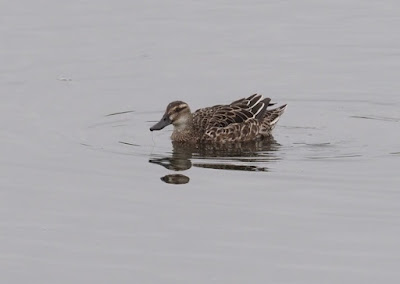
Shovelers are generally scarce visitors to the neighbourhood so is it nice to be able to report on what was probably a succession of birds at Loch Connell, including six on the 19th.  Also here, and on the same date, were a handful of Wigeon, two Pintail, 137 Mallard, a Garganey (a regional rarity) and three Pochard - all in all a most memorable day.  Teal, incidentally, also peaked at this site but on the 27th when there were 126 birds.

 Garganey - drab from a distance but such beautiful highlights

Loch Ryan was no less interesting, but for a different range of species.  Should you desire to see Scaup then the seafront at Stranraer, round to Low Balyett, is always to be recommended.  At the Wig they are scarce.  A lonesome female here, from the 16th onwards, was therefore of interest.  Eiders were thankfully more common, with 281 on the 10th; they rapidly decreased thereafter.  As part of a national census of this species 110 birds were counted on the entirety of the loch, on the 16th.  Come the end of the month 70, or so, birds remained. Three male Velvet Scoters on the 24th were a welcome addition to the waterbirds that grace the bay at this time of year.  Common Scoters here peaked at 211 on the 10th.  Remarkably, eight male Long-tailed Ducks, still in in full breeding dress, were observed on the 29th.  Just a single Goldeneye was noted all month, on the 16th.  Red-breasted Mergansers were seen daily in Wig Bay, often very close to shore; they peaked at 213 on the 29th - an impressive flotilla by any standards. 

I cannot say that I ever tire of looking at Red-throated Divers.  In whatever plumage I find them they always induce a sigh of satisfaction in me.  They are very calming; and for that I am exceedingly grateful.  A flock of eight drifting lazily on the ripples of the tide made for a serene view on the 10th; the highest count of the month, however, was on the 24th when 35 were noted.  An immature Great Northern Diver on the 22nd was the only record of this species. 

The majority of Great Crested Grebes observed were adults in breeding refinery, though towards the month’s end a few winter plumage birds began to appear.  The highest count of this species about the Wig was ten, on the 28th.  The first Slavonian grebes of the season were sighted on the 15th, with a pair sporting brick-red necks and golden ear-tufts of summer plumage.  Nine birds in various states of dress were recorded on the 29th.  A one-stop wonder was a gorgeous Red-necked Grebe on the 20th, and looking better than any illustration you might find in an identification guide.  Little Grebe observations were confined to Loch Connell where, presumably, the same ten birds of the previous month were still in residence. 

Numbers of Shags on Loch Ryan increased, as expected, with the highest count of 186 on the 16th: of these 158 formed a regimented line on one side of the pier at Cairnryan.  If only counting birds could always be that easy!  By comparison, 37 was the peak tally of Cormorants on both the 10th and 28th.

Like many a bird of prey the Sparrowhawk  is an opportunistic hunter.  I also like to think of them as having an ’optimistic’ prowess.  And - as with any optimism - sometimes it pays off… and sometimes it doesn’t.  A female tucking in to a Woodpigeon lunch - a prey item of slightly greater size and weight than she - was proof enough of a gamble paying dividends, on the 8th.  A bird trying to catch hirundines in flight, on the 22nd, was the exact opposite: no doubt a juvenile blessed with pretentious arrogance!

Golden Plovers in flight

Waders are the bread and butter of birding on the shores of Loch Ryan in September.  A bewildering assortment of of species in varying plumages make a veritable feast  for the experienced stalwarts or a headache for those less practiced.  With approximately 20 species to go at there is plenty of scope for satisfaction and disappointment to be had.  The first Golden Plovers were 14 on the 9th, steadily increasing to 198 on the 24th and 617 at the Scar on the 28th.  Ringed Plover numbers hovered around 70 birds all month, whilst Turnstones peaked at over 100 on the 14th.  A Curlew Sandpiper was a notable find at the Scar on the 11th.  The WeBS count at Piltanton on the 12th logged a number of waders, including 222 Curlew, a Whimbrel, two Ruff, 42 Redshank and two Greenshank.

Seagulls are great!  Ooops!  Just offended many birders.  Seagulls - like fish, apparently - don’t actually exist. Big, bold, and fearsome - Great Black-backed Gulls are impressive beasts: a coalition of 12 birds formed an implacable jury as they stood on the Scar, on the 12th.  Far more numerous, and slightly less threatening looking, was a gathering of over 1000 Herring Gulls on the Wig flats in the early evening of the 22nd.  Their counterparts, Lesser Black-backed Gulls, were considerably fewer in number across the month: a flock of 48, followed by another 14 birds, all flying south on the 8th, were noteworthy: also, 25 birds doing the same on the 15th.

A group of Great Black-backed Gulls can be very intimidating

Gulls are renowned for being difficult to identify.  Close views are especially advisable when it comes to determine a rarity or something a little odd-looking.  Circumstances, however, are not always in the observer’s favour.  I was reminded of this when I viewed a distant gull at Loch Connell on the 12th.  First impressions suggested to me a Yellow-legged Gull but, after prolonged views - and even longer consideration - my thoughts switched to it being a hybrid Herring Gull x Lesser Black-back Gull.  Unfortunately my deliberations ended there.  The bird promptly flew away and now I - and you, reader - will never know its true identity. 

What with rain on some days, fine on others, seeing hirundines has been very much a chance affair of late.  The highest count of Swallows was 114 on the 22nd, with the peak of House Martins on the 20th, when in excess of 200 birds fed at altitude.

Long-tailed Tits receive little attention in the blog, mostly because they are quiet and small enough to go undetected.  It was reassuring to be able to confirm their continued presence when a party of ten was espied amongst shore-line trees, on the 8th.  Song Thrushes are similarly elusive at this time of year.  I took the one I saw on the Wig track (also on the 8th) to be a sure sign of autumn passage in progress, however improbable that might seem to non-local readers.

Artistic rendition of a Long-tailed Tit

A smattering of Wheatears across the month was a welcome change to the absence they displayed the previous year: six birds in close proximity on the 21st was a heart warming sight.  Meadow Pipits are typically birds of passage about the Wig.  Flocks here are generally small compared with some other parts of the region: 22 on the 21st and 18 on the 28th were thus notable.  Their cousins, Rock Pipits, are generally solitary, so a party of 19 working its way along the beach at Kirkcolm on the 14th was a surprise as well as being unprecedented.

Regular readers will be aware that Greenfinches are generally rare on the local patch.  This time of year, however, they sometimes become more frequent when birds from elsewhere pass through the area.  Just eight at the Wig on the 24th kept them firmly in the ‘rare’ category, in my opinion.  September is always a troublesome month for the identification of Twite and Linnet.  It lies on the cusp of Linnets departing the area for their wintering quarters and Twite moving in to occupy the habitat vacated by their cousins.  Given good views the species are relatively easy to distinguish - but, from a distance and out of earshot flocks become ‘little brown jobs’ (LBJ’s) and separating them then becomes nigh impossible.  A flock of 130 birds on the 18th may have been either species - or, indeed, a combination of the two.  Upwards of 300 birds in the appropriately known ‘Twite Fields’, on the 27th, were definitely their namesake - recognised by their characteristic, buzzing, twittering.  The following day, the 28th, there were fewer Twite but 83 Linnets.

This article and the images contained within was supplied by courtesy of S. Grover