Sunday, July 17, 2022

2 for the price of 1! - May and June 2022 Bird Report

This article and the images contained within were provided by courtesy of the author, S. Grover


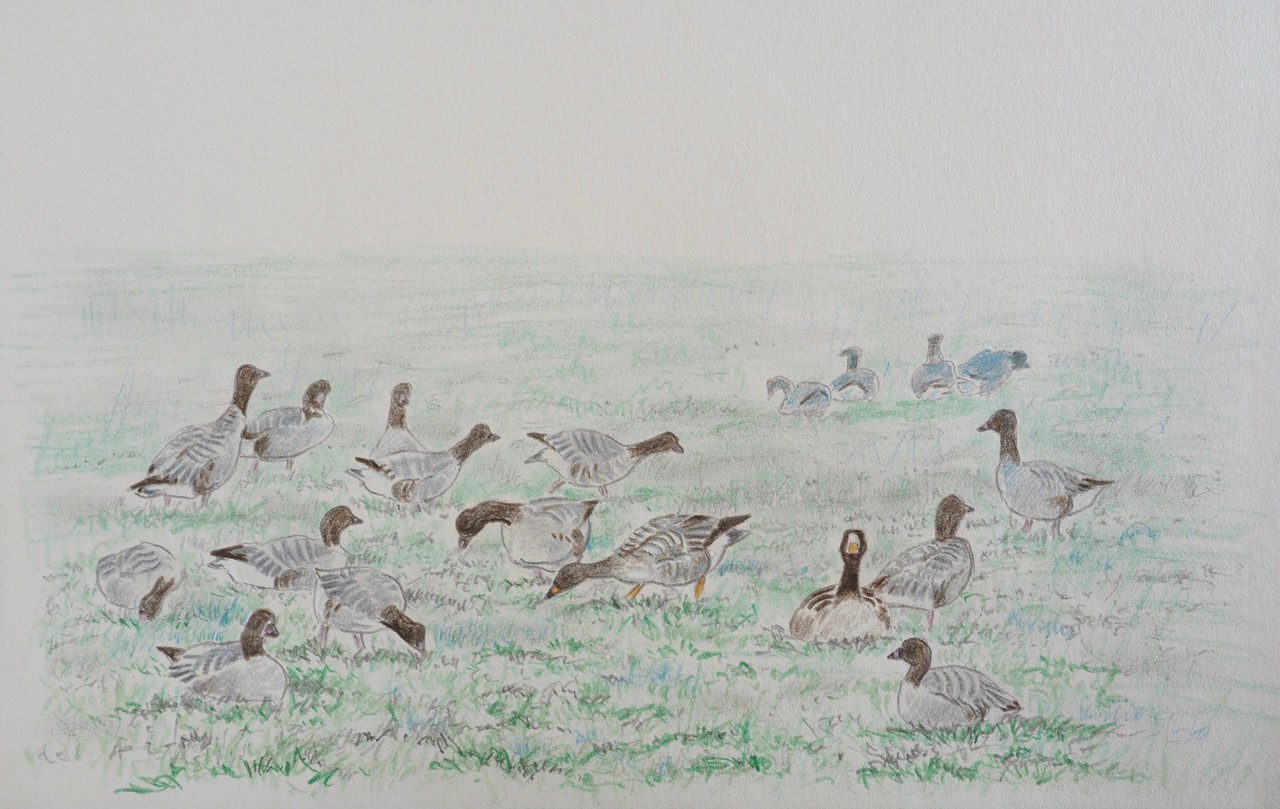
I thought the last Pink-footed Geese of the winter season were the three I saw at Loch Connell on the 2nd May; however, two birds were later noted there on the 12th June and where they continued to remain until at least the month’s end; presumably these were ‘pricked’ birds that were unable to migrate any further north.  At the same site and on the same date a pair of Canada geese were recorded with six near fledged youngsters in tow - nothing unusual in that I hear you cry, dear reader, but what was odd was that only two of the goslings were Canadas’, the other four being Greylags and presumably adopted by the parent geese: they stayed together as a family unit throughout the month.


Eight adult Mute Swans were observed flying down Loch Ryan on the 2nd of May, whilst 7 immatures were at Loch Connell on the 8th.  In June numbers of them on the sea loch began to increase and by the 29th there were some 24 birds.  The regular pair occupying Agnew Park were observed with 11 cygnets, on the 16th June.


The drake American Wigeon seen at Loch Connell at the end of April was still present into May, showing well on the 1st and briefly on the 2nd.  On day one I was content to visually enjoy this rarity but on day two I thought that perhaps I ought to try and capture a better photographic record than the crude images I had so far taken of the bird.  When I arrived at the site I found the duck exactly where I expected it to be.  After a few minutes, however, it paddled out to the middle of the loch.  I suddenly became distracted by a party of Whimbrel and when I returned my gaze to the spot of my previous observation the Wigeon had gone!  I checked and rechecked the water’s surface, the margins, the banks and the sky above but all came up blank.  Curiously - to me, anyhow - the following week, on the 8th, I was back at Loch Connell and saw a lone drake Wigeon occupying the very same spot where I had originally found its American cousin; there were even two male Mallards next to it, fitting perfectly with my memory of the original sighting - an uncanny repetition of events (bar the American visitor, of course).  Talk about de ja vu!  For an instant I thought that perhaps I had just imagined the vagrant species, but then I remembered the ‘record shot photos’ I had secured, and normality was restored.


The number of male Eiders on Loch Ryan can increase rapidly at this time of year when birds arrive from elsewhere to this traditional moulting site.  At the beginning of May there were around 40 or so birds; come the 27th I counted 140; the next day 245, and on the 30th they tallied 357.  The first brood of the season was also observed on the 30th when a female with two recently hatched ducklings was present at the Wig.  The following month saw no increase on the maximum number of males although their appearance changed considerably; at the close of June the majority wore a predominantly black, eclipse, plumage.  On the 24th a large seal was was observed hunting a party of drakes that had been rendered flightless through the moulting process.  A small number of broods were seen about the Wig during the month; none, however, was particularly large - four bite-sized ducklings on the 22nd.  On the 24th two larger offspring were observed, wearing a combination of fluffy down and proper-looking feathers.


Last of the winter Goldeneye


On the 5th of May the Wig held a drake Long-tailed Duck in full summer plumage and a male Goldeneye on the 12th.  These constituted the last of the ‘wintering’ birds for their respective species.  Common Scoters were present on Loch Ryan to at least the 17th of May when 28 were logged, although the peak count came on the 7th when 60 were present.  Only three birds were registered in June, on the 3rd.  Velvet Scoters were surprisingly well represented early on in May with eight males on the 1st and the last record, of six males, on the 5th.  The highest counts of Red-breasted Mergansers was 54 on the 2nd May and, in June, 35 on the 19th.

As expected Red-throated Divers were frequent visitors on Loch Ryan throughout the month of May, with a high of 26 birds on the 1st and a more than respectable 17 on the 29th.  There were just two records in June: a singleton on the 1st and another on the 5th.  Great Northern Divers showed well, being noted on nine days across the month of May; three were present on the 3rd and 5th with single birds thereafter; in June there was one on the 3rd.  In their breeding plumage they are most handsome birds and in this respect those I saw did not disappoint.  The 29th of May was a memorable day: not only did I see a splendid Great Northern, but alongside it was an impressive, immature, White-billed Diver.  A direct side-by-side comparison of these two species is not something I have often experienced; needless to say it was a fascinating privilege.  And all this before breakfast, I should add.  Great stuff!  


White-billed (left) and Great Northern Diver


Fulmars over Loch Ryan are something of a scarcity these days.  One on the 25th of May was a reassurance of their continued existence.  Gannets, meanwhile, hardly require any effort to find at this time of year.  The biggest count of them in May was 99 on the 22nd, whilst in June there were 94 on the 11th.  Adult birds form the bulk of sightings.  The first immature bird of the season revealed itself on the 11th of May: its plumage suggested to me that it was either a second or a third year bird.  Other immatures showing plumages ranging from second to fourth calendar year were sporadic visitors in both May and June.  One bird in particular stood out, on 19th June, wearing an almost juvenile-like plumage (mostly brown overall): presumably it was not a bird that had fledged from a nest this year (an exceptionally early youngster, if so) but an older bird retaining juvenile feathers.  June saw a distinct increase in the number of Cormorants on Loch Ryan as juveniles from local breeding sites joined the population; 29 birds were registered on the Scar on the 27th of the month.

Perhaps the highlight of May - for me, at least - was a Corncrake singing from within the ‘Pool Field’, adjacent to the Corsewall Burn and Fisher’s Lane, on the 3rd.  Like the White-billed Diver it was another example of ‘a one day wonder’, turning up unexpectedly.  Hearing the crake was one thing, laying eyes on the bird was something else.  I followed the noisy outbursts the bird emitted as it progressed across the field, in a skulking fashion.  Occasionally I caught a glimpse of a head, a back, or some other part of the bird but more typically it was seeing the movement of herbage that allowed me to track its course until it once more gave snatches of song. I consider myself fortunate to have been in the right place at the right time.


Of the smaller-sized waders a spritely Common Sandpiper at Bishop Burn on the 15th of May was a nice find.  There appeared to be a small but steady passage of Dunlin at the Wig and the Scar, with a peak of 16 birds on the 4th of May.  On a Wetlands Bird Survey count at Piltanton, however, 30 were registered on the 15th.  Just one record of the species occurred in June, comprising five adults in breeding plumage at the Scar, on the 9th.  Ringed Plovers were more frequently encountered, with a high of 78 observed foraging in a recently reseeded grassland at the Wig, on the 12th of May.  Come June the largest flock noted was 14 on the 1st and there were no sightings after the 9th.  In the same field that held the aforementioned plovers were two Sanderlings on the 12th and three on the 14th of May.  Larger waders included two Black-tailed Godwits at the Wig on the 26th of May, a singleton male Lapwing in grassland beside the Wig, on the 20th, and possibly the same bird at Loch Connell, on the 25th of the month. Single Bar-tailed Godwits were seen at the Wig on the 1st and the 5th of June.  Whimbrel also continued to pass through the area, with the fields surrounding Loch Connell being most favoured: 58 birds being the largest flock, on the 8th of May.  In the same month there were scattered sightings of Curlews, including a party of eight at the Wig, on the 5th.  Some of these, I suspect, were failed breeders rather than true passage birds.  The following month Curlew sightings increased, with 19 noted on the 29th June.


A party of aerobatic Arctic Terns

Herring Gulls are one of the commoner species, or at least more obvious than some others; consequently, my counts of them are generally few and often ad hoc.  Over 600 at the Scar, on the 16th of May, seemed an unusually large gathering.  Also unusual for this month were seven Kittiwakes on the 27th and a flock of 25 seen loafing on the waters off the Wig, the next day, the 28th.  In the same area, an Iceland Gull was a surprise visitor on the 20th.  Arctic Terns were seen briefly on three occasions during early May, the largest flock comprising 14 birds flighting northwards past the Scar on the 12th.  There was just one observation of Common Terns: two birds on the 7th.  For both these species of tern it was a disappointingly poor showing.  Sandwich Terns were considerably more numerous and frequent.  A high of 74 was at the Scar on the 4th of May, whilst in June 30 was the largest count on the 13th.


There is a tendency amongst humans to take common species for granted.  They rarely receive the attention that rare species seem to command.  This is certainly true for the humble Woodpigeon.  Sizeable flocks of them may be seen during the winter months but come the Spring their gatherings are much reduced; 50 of them seen feeding in a field beside the Wig on the 18th of May were to my mind, noteworthy.  Crows, too, are similarly ignored by the birdwatching brigade.  On May the 12th I saw a large congregation of them foraging in a field bordering Loch Connell.  The pattern of black shapes against the uniform green of the grassland caught the artists’ eye in me.  As  I considered the many possible compositions that the various groupings and interactions of the birds suggested to me, I realised that I had not yet even identified them to species level, nor approximated their number.  Here then, for the record, there were in excess of 730 corvids comprising some 620 Rooks, and the remainder, Jackdaws.  A dapper bonus bird seen flying west past the Wig, on May 31st, was a Hooded Crow.


The productivity of breeding Skylarks is hampered by farming practices, notably the timing of silage cuts.  The Wig Fields held six singing birds on the 3rd of May but how successful their breeding attempts were remains to be seen.  So few House Martins and Swallows seem to frequent the village of Kirkcolm these days that their numbers are hardly worth mentioning though their increasing scarcity make the species noteworthy.  As for Swifts, well, … they are just rare: a singleton on the 23rd of May was the only record in the neighbourhood.


The early spring is enriched by the songs of migrant warblers.  Come May the number of these birds in song declines as birds settle to nest and concentrate on raising broods.  A walk through the Corsewall Estate on the 3rd of May revealed seven Blackcaps, eight Chiffchaffs, five Sedge Warblers and ten Willow Warblers in song; thereafter, the woods, copses, scrublands and marshlands seemingly became bereft of these sounds.


Sadly, there was just one sighting of a Spotted Flycatcher: an adult at the edge of the estate marsh on the 15th of June.


The distribution and the numbers of pairs of breeding Stonechats fluctuates widely from one year to the next on my local patch.  I unexpectedly came across a pair with four, pleasantly, plump, juveniles in a drier part of the estate marsh, on the 15th of June. The first Wheatear of May was a large, strongly coloured, male of the Greenland race, observed about the Wig on the 3rd and 4th.  Three other singletons were seen here on the 8th, 11th and 12th, with none thereafter.  White Wagtails were similarly spartan and their spring passage brief, with individual birds on the 8th and the 11th and two on the 12th of May. 


The handsome male Greenland Wheatear

In the recent past you will no doubt remember the decline of our farmland and song birds being head-line news, in at least the conservation press.  In particular, the Song Thrush - being a familiar bird to country and urban dwellers alike - becoming a high priority species of nature conservation concern.  The story of its plight and fortunes has since faded into the background as other species have supplanted it in the public media . . . but I continue to research its predicament, locally at least.  I was pleased to record nine singing birds on the 5th of May.


A gaudy male Greenfinch was a surprise songster in my garden on the 3rd of June.  He was intermittently seen, or heard, thereafter up until the 13th of the month.  Linnets - another of those declining farmland species - are still widespread on my patch.  A flock of 35, on the 3rd of May, were clearly on passage.  On the same date, but at the Scar, a pair of Twite were unexpected visitors.  Although Reed Buntings have a distinctive song it is not particularly tuneful or prolonged to readily invite retention in the memory, other than in others of its own kind.  It is thus an easy species for people to pass by when there are more enticing sounds to be heard.  Clearly, on the 15th of June I had no such competition to draw away my attention because I logged three breeding pairs within  a small area of marshland.


Monday, May 23, 2022

Good Luck for Ducks! - April 2022 Bird Report

This article and the images contained within were provided by courtesy of the author, S. Grover

Pale-bellied Brent Geese were daily visitors to the Wig Fields up to mid-month.  Up until the 10th numbers of birds were fairly constant, hovering around the 160 mark, with a peak of 192 on the 4th.  Thereafter, however, numbers dropped but stayed at about 60 birds, including on the 17th when the last were seen at the Scar.  Records of Pink-footed Geese were few, with the highest count being five birds at Loch Connell on the 23rd.  The only record of Greenland Whitefront also came from this site, on the 3rd, when an adult was seen in an adjacent field.

There were just two sightings of Mute Swans: four birds at the Wig on the 13th and six immatures at the same site on the 27th.  Whooper Swans were present at Loch Connell, with a high of eight birds on the 10th, reducing to two on the 16th.

Wigeon numbers dropped off appreciably.  Three were at the Wig on the 5th; a few more were noted at Loch Connell, with 25 there on the 3rd, reducing to two birds on the 10th.  The only other wigeon sighting I made came at the end of the month, on the 30th, also at this site.  It was exceptional in that it was an American Wigeon - a handsome drake that kept his own company.  Incidentally, this marked my first record of the species on my local patch in my 14 year tenure here.  Mallard are rarely mentioned in this blog.  Perhaps this is because they are, supposedly, the commonest of the the so-called ‘wild ducks’.  The striking plumage of the male - with a dark head and neck that shows an iridescent sheen of green and purple in certain lights - would likely command considerably more attention from birdwatchers, if only he was a rarity!  It is the females, however, that I focus your attention upon here; in particular, two birds with an entourage of 17 recently hatched offspring between them.  How long any of these ‘bite-sized’ meals will ever reach maturity remains to be seen.  Teal are primarily winter visitors to the area.  Like many such transient species their departure can be either sudden - here one day, gone the next - or protracted, as seems to be typical for teal.  At Loch Connell there were 22 birds on the 10th, halving in number to 11 on the 23rd, and with just two birds present at the month’s close.

The Resplendent Drake American Wigeon 

Loch Connell held but a handful of Tufted Ducks across the month.  However, a trip out to Lochs’ Magillie and Soulseat ( a little to the south and east of Stranraer), on the 17th, resulted in higher counts of 17 and 48, respectively.  Also on this date, but from Bishop Burn, Loch Ryan, 31 Scaup were logged.  The numbers of Eiders on this sea-loch remained low throughout the month, with the highest count being 52 on the 22nd.  An impressive (for the locality, that is) eight, drake, Velvet Scoters were first observed on the evening of the 28th, when they drifted inconspicuously on the calm water out in the middle of the loch.  From such a distance they would have gone undetected to the naked eye and to the relatively low magnification of field glasses, but with the aid of of a powerful spotting scope their presence, and identification, were within my grasp.  The more abundant Common Scoters, peaked at 82 birds on the 13th.

I had all but convinced myself that any wintering Long-tailed Ducks had departed for their breeding grounds some time ago, but a ‘brown’ drake at the Wig, on the 29th, proved otherwise.  I do not believe that I am alone in thinking that male, ‘Oldsquaw’, as they are referred to in the high arctic  where they breed, are more handsome in their ‘harlequin’ winter plumage than in their more drab-looking summer apparel.  For most species of birds the opposite is generally held to be true.  As to be expected, there were also fewer Goldeneyes to be seen this month.  The 13th produced my biggest count of 11, whilst at Loch Connell, on the 30th, there was still a first-summer male present.  Also at this site, but on the 10th, was a ‘redhead’ GoosanderRed-breasted Mergansers were well represented at Loch Ryan throughout the month; they peaked at 108 birds on the 5th.

A late leaving Long-tailed Duck in summer plumage

Red-throated Divers were seen daily about Loch Ryan; there were particularly high counts of 107 on the 18th and 25th.  In comparison there were just two registrations of Great Northern Divers: singletons on the 6th and 29th.  A handful of Slavonian Grebes  remained during the early days of the month, with the last three birds - in splendid breeding plumage - being seen at the Wig, on the 13th.

Good numbers of Gannets were present most days about the sea-loch: 107 were recorded on the 25th.  As is typical for the time of year, all were adults.

The majority of waders in the locality are seasonal visitors, to a lesser or greater extent.  But there is one constant: the Oystercatcher.  Although few breed along the shores of Loch Ryan - and those that do seem rarely to be successful - there can always be found flocks of others that, for whatever the reason, remain in the area; summer flocks being smaller than those found in winter.  The 133 I counted at the Scar on the 25th were a typical sized congregation for the time of year.  Lapwings are one of the scarcer species on my local patch.  There were just two at Loch Connell on the 30th.  Golden Plovers are generally commoner visitors, though with good weather predominating the month, any passage birds likely enough went through the area without stopping: five birds on the 15th constituted the only record.  Ringed Plovers were more frequently observed, with the highest count of them being 20 on the 23rd.  Whimbrel are a typical passage species in May and there were numerous sightings, the first being a singleton at the Scar, on the 12th, rising to 24 at Loch Connell, on the 30th.  Over this period 61 birds were registered but I guess there were many more that went unseen, or unheard, as their ‘seven-note whistles’ are distinctive.  Compared with their cousins, Curlew were distinctly fewer in numbers.  The majority of this species that winter in the area depart early for their breeding grounds.  A party of 26 birds were noted on the 3rd, quickly reducing in number thereafter, with just a single bird on the 25th.  There were two observations of Bar-tailed Godwit: a single at the Wig on the 1st and two there on the 4th.  (This, incidentally, was mirrored exactly by Redshank).  Black-tailed Godwits were equally spartan, with two at Loch Connell on the 10th, and a bird heard calling at the same location on the 23rd.  As to be expected, Turnstones were also fewer on the ground, with a high of 20 at the Scar on the 11th.  Knot are never common in the spring: one at the Scar on the 20th was a lucky find.  Numbers of Dunlin are also low at this time of year; a Wetland Bird Survey count at Piltanton on the 17th resulted in a flock of 20 being logged.  Single Snipes seen flying off the Scar were nice discoveries on the 18th and 25th.  A Common Sandpiper seen on the beach at Kirkcolm, on the 22nd, was my first of the year at this locality.

Whimbrel congregate in the fields around Loch Connell

Sightings of Kittiwakes about Loch Ryan are often reliant on north-westerly winds over the North Channel pushing them landwards.  Sometimes, however, they just turn up out of the blue, unannounced, without any apparent reason for being there: like the three that passed the Scar on the 7th.  Common Gulls have pretty much vacated the area by May; three on the 5th and six on the 7th were the only observations.  Herring Gulls are ever present, although a count in excess of 700 birds on the exposed flats at Kirkcolm Point, on the 2nd, was unusually high for the season.  Lesser Black-backed Gulls are usually sighted in ones and twos during the spring, so a party of 12 adults at Loch Connell on the 16th was an unexpected delight.

Sandwich Terns were observed almost daily, beginning with 17 at the Scar on the 2nd, increasing to 44 there on the 20th, then 80 the day after, rising to a peak of 102 on the 23rd.  The only observation of Common Terns was five birds about the Wig on the 29th.  The first Arctic Terns arrived a little earlier than the preceding species, with six at the Scar on the 21st.

Razorbills are reasonably common visitors to Loch Ryan during May, but observing them can be challenging because they typically occur well off-shore.  The largest counts were 22 birds on the 8th and the 18th, with a peak of 24 on the 9th.

Typical of their scarcity status on my local patch there was but one record of a Cuckoo calling from the estate woods on the 27th.  A surprise observation was that of a fast moving Merlin over my house, on the 10th.  Equally surprising was a Magpie, seen just outside my garden, on the 3rd and a Hooded Crow perched on a telegraph wire, in the same area, on the 20th.  I also saw this species ten days earlier, at Loch Connell; but whether or not it was the same bird on both occasions I know not.

Should a person be so inclined to log their first hirundines of the year, then a large body of open freshwater is a recommended place to start looking.  On my patch that means a walk to Loch Connell.  However, I did not see my first Sand Martins there until the 16th, when I logged 58 birds.  Swallows were earlier to arrive, with a single bird over my house on the 10th.  The afore mentioned freshwater loch, however, held 26 birds on the same day as the Sand Martins were noted, along with the first returning House Martins, of which there were three.

The first of the summering Willow Warblers conveniently appeared in my garden on the 12th.  By the 18th of the month there were at least six singing birds in the estate woods and come the 28th there were 13.  Chiffchaffs arrived earlier, and in the same woods there were five singing on the the 8th, then eight on the 18th, and 11 on the 28th.  I did not detect the first local Sedge Warblers until late in the month, on the 27th; that, in all probability, was a consequence of my not passing their usual haunt - the estate marsh - which just happens to be out of earshot of my house.  Also on the 27th, the first Whitethroat of the season was logged in the archive.  Blackcaps have been singing right through the month.  Three were noted on the 8th, increasing to 19 on the 28th: an impressive tally and up considerably on last year.

A handsome Willow Warbler takes a peak from within the vegetation

Spring Wheatears about the Wig have been notable by their absence in recent years.  This May, however, I was lucky enough to happen across eight bird on six days.  It is likely that they were all birds of the ‘Greenland’ race, which are generally bigger and brighter than their ‘British’ counterpart.  The bird I saw on the 23rd definitely was a bigger fellow, with stronger colouration and those all important ‘six primary tips’ showing beyond the tertial feathers on the closed wing!  A nice bird, anyway.

One of the delights of the month has been waking up to the twittering of a male Siskin that has adopted the the birch tree in my garden as one of its song posts.  It has been a welcome addition to the sounds drifting through the open windows, whilst adding variety to the monotonous ‘cooing’ of Collared Doves and Feral Pigeons that dominate the bird song in the locality.  Although the surrounding countryside has been filled with the gay chorus of Linnets, their ‘mountain’ counterparts, Twite, have been absent all month.  In the past there have been a few birds lingering but, sadly, not this year it seems.


Tuesday, April 12, 2022

The Multitudes of March - 2022 Bird Report

This article and the images contained within were supplied by courtesy of the author, S. Grover.


Pale-bellied Brent Geese were daily visitors to the fields beside the Wig track, with a high of 205 birds on the 15th. This count included a long staying individual which, for some reason, mostly kept its own company and even remained when all of the others had gone elsewhere. This might suggest that the bird was injured - and perhaps it was - but its actions both on the ground and in flight proffered otherwise.


The fields bordering Loch Connell were regularly frequented by geese, mostly Pink-footed. This species peaked here at 1089 birds on the 27th; lesser numbers on the 13th had with them an adult Greenland White-front and a Tundra Bean Goose.


Pink-footed geese with Tundra Bean Goose (centre) and Greenland White-front (centre-right)

Whilst sitting down to eat tea on the 19th I saw a flock of Whooper Swans approach from the south and settle at the Wig. They totaled 65 in number. Their incessant calls drifted across the intervening land and penetrated the panes of window glass of the house, producing a muffled chorus of pleasing tones that accompanied the evening meal. The serenity was blissful, and might only have been bettered by the addition of a nice, open, bottle of claret!


There were ten Shelduck at the Scar on the 4th; thereafter, pairs of birds were observed searching banks along the shore and inland, presumably, on the look out for suitable nesting sites. Two drake Shovelers at Bishop Burn was a nice surprise on the afternoon of the 20th; a male and a female were observed at Loch Connell (a site which has held nesting pairs in the past) on the 27th.  Wigeon have mostly moved on now, leaving smaller flocks here and there, including 87 at the Wig on the 3rd.  Goldeneyes continue to linger, or pass through, with 24 on the 3rd and 17 on the 28th.  Long-tailed Ducks definitely became scarcer as the month progressed; however, 17 were noted on the 3rd and 12 on the 16th.  Similarly, numbers of Scaup on Loch Ryan dwindled, although 179 were noted off Bishop Burn on the 20th and a female continued to to be seen on the freshwater of Loch Connell to at least the same date.  Common Scoters, as expected, were regular in occurrence on the sea loch, with 111 recorded on the 25th.  Velvet Scoters were noted on several occasions from mid-month onwards: a party of four were observed on the 14th and the 28th. A drake and duck Goosander were an unexpected bonus at the Wig on the 22nd, whilst the more usual haunt of Loch Connell held nine birds on the 6th.  At this time of year Red-breasted Mergansers are especially tricky to count with any accuracy, what with highly mobile parties of both courting and passage birds about. Up to the 25th of the month 46 was the highest count I registered, but a sudden influx on the 28th revealed 164 birds.


Black-throated Divers are unpredictable as to when they turn up on Loch Ryan.  That classic adage: ‘being in the right place at the right time’, springs to mind.  In other words, Lady Luck is either smiling with you … or, against you.  Clearly she was with me on the 3rd when a bird graced the waters of the Wig.  The Pacific Diver was not so obvious this month as last, with records on the 3rd, 14th, 15th and 16th. The following day, the 17th, was, however, incredulous; not only was there our regular ‘friend’, (as I have come to regard it), but it was accompanied by an immature bird of the same species!  Perhaps the arrival of a second bird was cue for the departure of both because neither were seen thereafter.


The only record of a Great Northern Diver on the loch was on the 28th.  Red-throats’ were more frequent visitors, with 38 being the highest count, also on the 28th.  The majority of those observed were still in winter plumage, or were immatures; a small number, however, were summer adults, sporting brick-red throats. Slavonian grebes were also present throughout the month. Unlike the preceding species most of those I saw were fully attired in breeding dress, with striking russet-coloured necks, bright-yellow horns, or ear-tufts, set off by glistening red eyes.  If you think that one bird on its own is stunning to behold then try to imagine the party of eight such birds that I saw close in-shore at the Wig on the 25th.  I had to pinch myself just to make sure that I hadn’t drowned on the incoming tide and gone to heaven!


Slavonian Grebes in their magnificent plumage 


I did not record my first Gannet of the spring over Loch Ryan until the 10th.  Thereafter, small numbers were seen almost daily.  The numbers of Shags seen on the loch plummeted sharply at the start of the month as birds moved out to take up residency at their breeding colonies. Perhaps because of their absence the small numbers of Cormorants that remained seemed more noticeable to my eyes.

Waders also seemed a little thin on the ground, with wintering birds departing for their summer  breeding grounds.  Curlews were much reduced, although 65 on the 25th seemingly might not support this, whereas  just a single Dunlin at the Scar on the 4th may better persuade opinion. Golden Plovers were irregular visitors; many of the 98 birds seen at the Scar on the 25th were already showing advanced signs of summer plumage. The only record of Greenshank came from a Wetland Bird Survey count at Piltanton on the 20th, when three birds were registered. Most notable was the sighting of two Purple Sandpipers on the 20th, initially at the Loch Ryan Sailing Club and later flying eastward across Bishop Burn towards Low Balyett.  It is perhaps surprising that this species is seen so infrequently about the loch given that suitable habitat exists here, as well as at many other places along the west coast; a thought to ponder upon, if nothing else. The first Whimbrel of the spring period was a bird seen and heard at Loch Connell on the 27th.


A pair of flying Purple Sandpipers 

The sizeable winter population of Common Gulls in the area typically begins to disperse in late February.  Consequently the numbers seen here in March vary day to day but is generally low, 

especially towards the month’s end when there may be very few.  Kittiwakes are scarcer altogether, no matter what the season. There were seven on the 2nd, one on 13th, and four on the 21st. The only observation of a Mediterranean Gull was of one on the Scar, when a first-summer bird was noted. My first Sandwich Tern of the year was seen about Wig Bay, on the 13th, followed by another singleton on the 24th, six on the 28th and one on the 29th.


March usually sees the arrival of Razorbills on Loch Ryan, with birds having spent the winter further out at sea. Two birds were noted on the 17th, rising to 22 on the 28th.


The Barn Owl reported last month is still, thankfully, about. It made an evening appearance in my garden on the 17th and the 26th.  Two ‘hooting’ Tawny Owls on the 6th confirmed their continued presence in the area.


Male Great Spotted Woodpeckers advertise themselves at this time of year by ‘drumming’.  It was somewhat comforting to hear three of them doing exactly this in the estate woods on the 4th, especially given the the number of fallen wind-blown trees that are dotted about after the recent gales.


A Hooded Crow was a notable find on the 22nd when a bird was observed feeding alongside two resident ‘Hoody-hybrids’ in the Wig Fields.  Equally delightful were good views of a Jay in the estate woods, on the 30th, and a Magpie over my garden, on the 29th. (The latter  is still very much a scarce species in the neighbourhood).


A Hooded crow feels at home with the hybrids.

For many people warblers are a sure sign of Spring’s arrival.  Chiffchaffs are one of the first migrants to arrive. I heard three singing in the woods on the 16th, venting their plaintive songs that give rise to their namesake.  Blackcaps are often next; their melodious, flutey, songs giving away their presence.  Two birds were heard on the 30th.  Goldcrests are resident throughout the year.  Their high-pitched voices are often beyond the range of oldies like myself, but on calm days with no competing sounds I can sometimes still detect them … just!  A bird heard singing from high up in a larch tree was reward enough for me on the 16th.  Rather more exciting, however, was a different warbler that I espied down Fisher’s Lane, on the 25th.  It was in the same general area that I have seen the species numerous times before, flitting about the bushes and Sycamore trees.  It was a Yellow-browed Warbler - a species I typically encounter in autumn, rather than spring.


Despite being a, supposedly, common winter visitor Fieldfares are, generally, anything but on my local patch.  A party of six birds on the 20th was thus welcome and observed with thanks.


The colourful Siskin is probably a familiar sight to those of you who regularly feed the avifauna that so readily visit gardens, especially at this time of year when large numbers of birds pass through, increasing the likelihood of fly-byes dropping in to refuel.  Needless to say this species does not appear in my ‘top ten’ garden list.  A mere two birds, on the 24th, was better than none at all by my way of thinking.  And not too far away from my garden lies the Wig Fields - a refuge not so long ago for wintering Twite.  But with fewer wildflower seeds about these days so too have the Twite become fewer.  I was grateful to see a roving flock of some 30 birds strong, making use of the fields, on the 20th.